
Give way rules in NSW

Who goes first at signs, at intersections without signs, at T-intersections and at roundabouts.

Last reviewed: 28 November 2026, against the Road User Handbook.

In short

At an intersection without signs or lights in NSW, a driver who turns across another vehicle's path gives way to it, and every driver who turns gives way to pedestrians crossing the road being turned into. Turning right, you give way to a vehicle from your right and to oncoming vehicles going straight or turning left; on a road that ends at a T-intersection, you give way to all traffic on the continuing road. At a roundabout you give way to every vehicle already on it, whichever direction it came from.

What do you do at a Stop or Give way sign?

The red octagonal NSW Stop signStop sign or Stop line (a single continuous line across your lane): stop completely, before and as close as you can to the line, even on an empty road. Then give way as at a Give way sign.
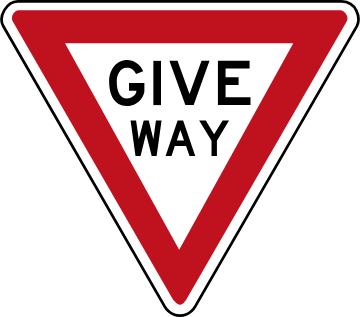
The NSW Give way sign: a white triangle with a red border, point downGive way sign or Give way line (a single broken line): slow down, be ready to stop, and give way to vehicles in, entering or approaching the intersection. The exceptions: you need not give way to an oncoming vehicle that also faces a Give way or Stop sign and is turning right, a vehicle turning left from a slip lane, or a vehicle making a U-turn.

Turning at either sign, also give way to pedestrians crossing the road you turn into. When two cars face Give way signs on opposite sides, the one turning right gives way to the one turning left.

Who gives way at an intersection without signs?

You areYou give way to
Turning righta vehicle approaching from your right; an oncoming vehicle going straight ahead; an oncoming vehicle turning left; pedestrians crossing the road you turn into
Turning leftvehicles on your right; pedestrians crossing the road you turn into
Turning right, and the oncoming car is turning right toonobody: both can turn at the same time, passing in front of each other

If another driver does not give way when they should, do not force your way through. Around half of all crashes on NSW roads happen at intersections, so approach slowly enough to stop.

Who gives way at a T-intersection?

If your road ends at the T-intersection, you give way to all vehicles on the continuing road, unless a sign says otherwise. If you are on the continuing road and turning right into the end road, you give way to oncoming vehicles going straight ahead or turning left. The same rules apply where the continuing road bends around the corner instead of going straight.

How do you give way and signal at a roundabout?

The NSW roundabout sign: a Give way triangle with circling arrowsSlow down or stop and give way to all vehicles already on the roundabout: those on your right, and those that entered from your left or from directly opposite. Then signal so others know where you are going:

  • Turning left: signal left as you approach and keep it on as you turn.
  • Going straight ahead: no signal on the way in (use any lane unless arrows say otherwise); signal left as you leave, if practical.
  • Turning right or making a U-turn: signal right, use the right lane unless arrows say otherwise, then signal left as you leave, if practical.

On a multi-lane roundabout follow the lane arrows, and change lanes only across a broken line after signalling and giving way. Bicycle riders may turn right from the left lane, giving way to vehicles leaving, so watch for them. At a roundabout you need not give way to pedestrians unless there is a pedestrian crossing, but you must take care not to hit anyone.

When must you give way to pedestrians at traffic lights?

When you turn at an intersection with lights, you must give way to pedestrians crossing the road you turn into, even if their symbol is flashing red: a flashing red means they must not start crossing, but they may finish. A flashing yellow arrow lets you turn, again giving way to pedestrians. If police or a traffic controller are directing traffic, their signals override the signs and lights.

Practise what you have read

Check yourself with questions on this topic: each answer has an explanation and a link to the Road User Handbook.

Questions and answers

Does the car turning left or right go first in NSW?

When two cars face each other and one turns left while the other turns right into the same road, the car turning left goes first. At opposite Give way signs the same applies: the right-turner gives way.

Do you give way to the right at a roundabout in NSW?

You give way to all vehicles already on the roundabout, not only those on your right: also those that entered from your left or from directly opposite.

Do you indicate going straight through a roundabout?

Not on the way in. Signal left as you leave, if it is practical.

Who has right of way at a T-intersection?

Traffic on the continuing road. A driver on the road that ends gives way to all of it, unless a sign says otherwise.

Sources

More guides

audriving.com is an independent practice website, not Transport for NSW. This guide is an unofficial study aid written from the official handbook; where anything differs, the handbook and Transport for NSW prevail. Fees and rules change: check them on the Transport for NSW website before you pay or book.