NSW speed limits

The default limits, the special zones, and the lower limits for learner and P plate drivers.

Last reviewed: 28 November 2026, against the Road User Handbook.

In short

Where no sign says otherwise, the speed limit in NSW is 50 km/h in a built-up area (street lights or buildings less than 100 m apart beside the road) and 100 km/h on other roads. Learner and red P1 drivers may never go faster than 90 km/h, and green P2 drivers 100 km/h, even where the sign allows more. School zones are 40 km/h on school days during the times on the sign, usually 8 to 9.30 am and 2.30 to 4 pm.

50 km/hbuilt-up area, no sign
100 km/hother roads, no sign
90 km/hmost a learner or P1 driver may ever drive
40 km/hschool zones in their times

What are the lower limits in special zones?

ZoneLimitWhat to know
Shared zone10 km/hPeople walking, riding and driving share the road. Give way to every pedestrian, stopping if you need to.
High pedestrian activity area30 or 40 km/hBusy CBD streets and small shopping strips.
Local traffic area40 km/hA group of local streets kept slow for safety and quiet.
School zone40 km/hBetween the 'School zone' and 'End school zone' signs, on school days, in the times shown. Inside a 30 km/h area the school zone is 30 km/h too.
Passing a school bus with flashing lights40 km/hChildren may be crossing. Applies while the lights on top of the bus are flashing.
RoadworksAs signed, often 40 km/hSigns show where the roadworks start and end. You must not go faster than the sign shows.
Passing a stopped emergency vehicle, tow truck or breakdown vehicle with flashing lights40 km/hWhere the limit is 80 km/h or less. Above 80 km/h, slow down safely and move over a lane if you can. Do not speed up until you have passed everyone involved.

When do NSW school zones apply?

Most NSW school zones operate from 8 am to 9.30 am and 2.30 pm to 4 pm on school days. A few have other times: their signs are red or orange and show the times. School days are set by the NSW Department of Education and include staff development days, so the zone can apply when you see no children.

Every school zone has at least one set of flashing lights that operate during the zone times, and "dragon's teeth" (white triangles) are painted on the road to make the zone easier to see. Speeding in a school zone carries a higher penalty than the same speed elsewhere.

What are the speed limits for learner and P plate drivers?

  • Learner (L) and P1 (red P): never above 90 km/h, and any lower posted limit applies. A single speeding offence of any size takes a learner or P1 driver over their 4-point demerit limit, so the licence is suspended.
  • P2 (green P): never above 100 km/h, even on a 110 km/h motorway.
  • More than 30 km/h over: police can suspend a learner's or P driver's licence and take it on the spot. For any driver the same happens at more than 45 km/h over, and the car or its plates can be taken away.

Which speed signs must you obey?

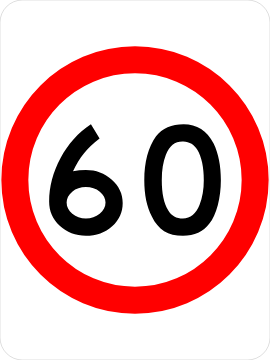
A NSW speed limit sign: 60 in a red circle on whiteA regulatory speed sign has the limit in black inside a red circle on a white background: you must not drive faster than it. Electronic variable speed signs in tunnels and on motorways are limits too, and change with traffic and conditions.

Advisory speed signs are yellow, usually under a curve or crest warning sign. They are not limits: they recommend the top speed for an average vehicle in good conditions, so go slower in rain, at night or in a heavy vehicle.

Remember that a limit is the most you may drive, not a target. Even within the limit you can be too fast for curves, rain, heavy traffic or night, and NSW has four kinds of speed camera: mobile, red-light speed, fixed and average speed (which times you over a long distance).

Does a few km/h over really make a difference?

Yes. Speeding is the biggest killer on NSW roads, a factor in around 40% of deaths. A pedestrian hit at 50 km/h is twice as likely to be killed as one hit at 40 km/h, and "only 5 or 10 over" is not safe speeding: there is no such thing. Do not let passengers talk you into it.

Practise what you have read

Check yourself with questions on this topic: each answer has an explanation and a link to the Road User Handbook.

Questions and answers

What is the speed limit in NSW if there is no sign?

50 km/h in a built-up area, where there are street lights or buildings less than 100 m apart beside the road, and 100 km/h elsewhere. Learner and P1 drivers still must not exceed 90 km/h.

Can a P2 driver do 110 km/h on a motorway?

No. P2 drivers must never drive above 100 km/h, whatever the sign says.

Do school zones apply in the school holidays?

No. They apply on school days, which include staff development days, during the times on the sign. The NSW Department of Education publishes the school days.

Is an advisory speed sign a speed limit?

No. The yellow advisory sign recommends a safe speed for a curve or hazard in good conditions. The legal limit is still the regulatory sign, but you should slow to the advised speed or below.

Sources

More guides

audriving.com is an independent practice website, not Transport for NSW. This guide is an unofficial study aid written from the official handbook; where anything differs, the handbook and Transport for NSW prevail. Fees and rules change: check them on the Transport for NSW website before you pay or book.